Top 5 Industry Trends Shaping Mining Reporting and Disclosure in 2026
Mining reporting expectations are evolving. Legal and finance teams are no longer assessed solely on the accuracy of individual disclosures, but on how consistently information is governed, aligned, and traceable across the full reporting set.
As Q1 reporting deadlines compress and disclosure volumes increase, legal and finance teams are often required to draft, revise, and reconcile annual reports, MD&A, financial statements, circulars, and press releases in parallel. Mondaq’s 2026 Canadian In-House Counsel Report found that 34% of in-house counsel cite workload as their biggest challenge¹, placing additional strain on coordination across tightly linked reporting documents that rely on shared terminology and recurring narrative language.
These shifts are changing how mining companies approach disclosure workflows. Accuracy remains essential, but consistency, auditability, and operational transparency are becoming equally important when updates are applied across multiple filings under tight timelines.
This article explores the industry trends shaping mining reporting and disclosure in 2026, and what they mean for legal and finance teams preparing for the next reporting cycle.

Mining legal and finance teams are increasingly using A.I.-assisted tools to support drafting, review, and reporting workflows. In practice, these tools are now embedded across multiple stages of the disclosure process, from preparing MD&A narratives to reviewing forward-looking statements and coordinating supporting materials.
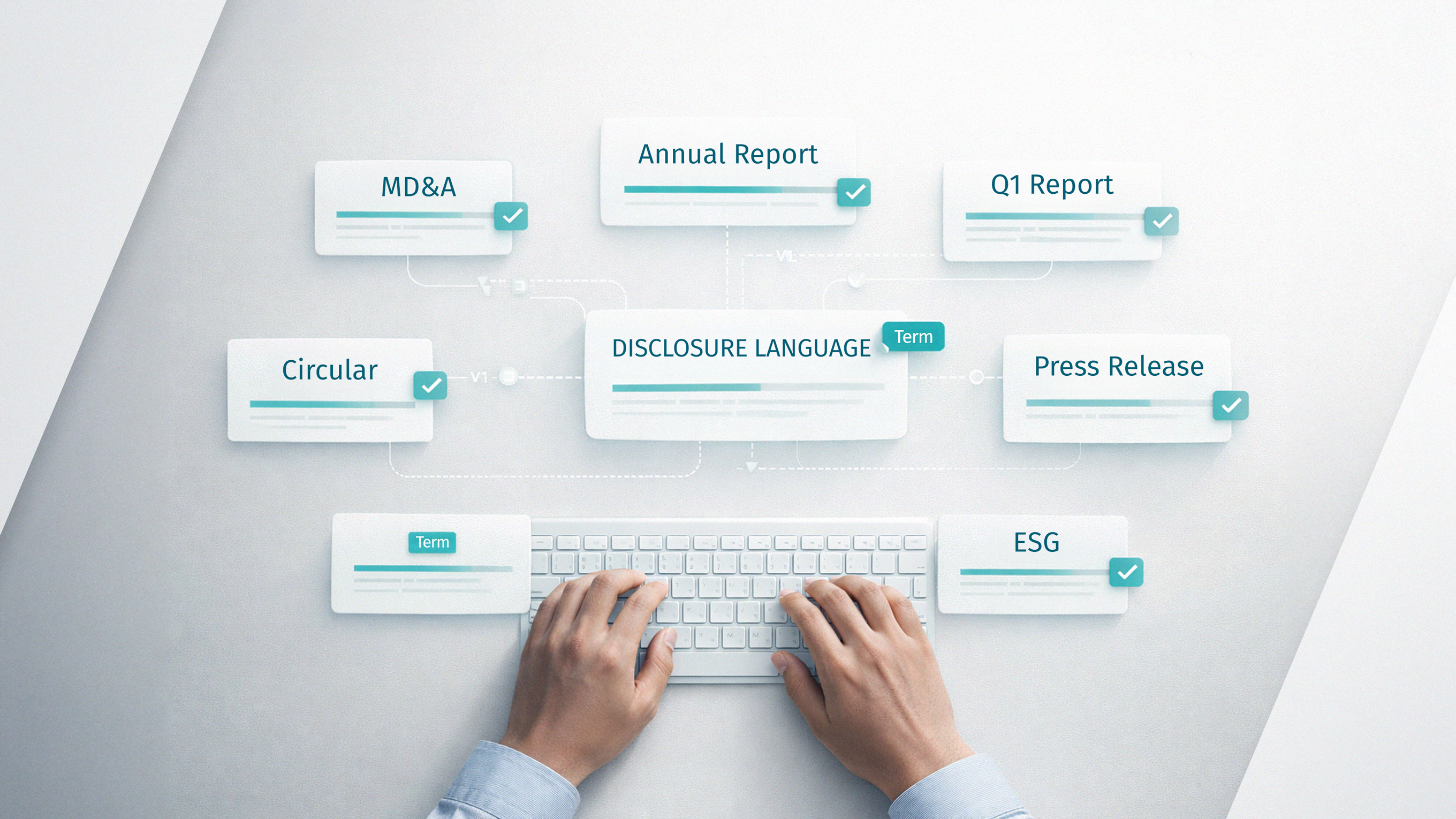
Across the industry, reporting environments are evolving toward parallelized drafting practices, where disclosures that share defined terms, technical language, or recurring narrative content are developed simultaneously across annual reports, MD&A, financial statements, circulars, and press releases. As revisions are applied across these materials, shared disclosure language may evolve at different points in the reporting cycle when coordination is managed across multiple teams or external vendors.
This shift toward tool-supported, multi-document drafting environments is introducing new coordination requirements to ensure that reused terminology or recurring disclosures are updated consistently across related filings.
Mining companies are reassessing how disclosure and reporting workflows are supported as regulatory requirements continue to evolve. In many cases, this is prompting increased investment in legal and reporting technologies designed to improve coordination, version control, and oversight across financial and sustainability disclosures.
49% expect increased spend on legal technology2, reflecting growing pressure to modernize reporting processes that were not originally designed for parallel drafting, late-stage revisions, or multi-stakeholder review.
As reporting workflows become more digitally enabled, legal and finance teams are prioritizing:
Without the right coordination infrastructure, these investments may improve speed without improving consistency across linked disclosures that share defined terms or recurring narrative language.
In response, some organizations are formalizing how reporting workflows are supported operationally, separating legal interpretation from document coordination to improve both consistency and cost predictability during peak reporting periods.
As disclosure requirements expand, legal and compliance leaders are placing greater emphasis on how reporting processes are executed across multiple documents developed in parallel.
A.I.-assisted drafting environments, shared document repositories, and collaborative review platforms now play a larger role in how financial and investor-facing disclosures are prepared.
As a result, updates to recurring disclosure language such as defined terms, forward-looking statements, or risk narratives may be applied at different points in the reporting cycle when coordination occurs across teams or external partners.
As reporting execution becomes more dependent on collaborative platforms, mining companies are placing greater emphasis on how recurring disclosure language is documented and tracked across parallel drafting environments.
Download Reporting-Grade Translation for Mining Companies to see how consistent your annual reports, MD&A, and financials really are across your full reporting set.
Environmental, Social, and Governance (ESG) disclosures are becoming more tightly integrated with financial reporting requirements across mining organizations.
Standards such as the GRI 14 Mining Standard and evolving sustainability disclosure frameworks are increasing expectations that ESG metrics, risk statements, and forward-looking narratives align with related financial and operational disclosures. This is prompting legal, finance, and sustainability teams to collaborate more closely throughout the reporting cycle.
As ESG reporting becomes more formally incorporated into annual reports, MD&A narratives, and investor-facing materials, disclosures that were previously managed in parallel must now remain consistent across the full reporting set. Updates to sustainability risks, climate-related assumptions, or operational outlooks may require corresponding adjustments to financial guidance or supporting narrative language.
In practice, this is increasing the need for structured coordination across reporting workflows. Inconsistent terminology, outdated assumptions, or misaligned disclosures between ESG and financial reporting materials are more likely to be identified during regulatory review or investor scrutiny.
As reporting environments continue to converge, mining companies are placing greater emphasis on integrated disclosure processes that support consistency across financial, operational, and sustainability reporting cycles.

Evolving expectations across financial, ESG, and A.I.-supported disclosure workflows are placing greater scrutiny on how operational reporting processes are structured and executed.
Legal and finance teams are being asked not only to ensure that disclosures are accurate, but that supporting workflows can maintain consistency across documents that are drafted, reviewed, and updated in parallel. In practice, this includes recurring disclosure language, defined terms, and forward-looking statements that appear across annual reports, MD&A narratives, financial statements, and investor-facing materials.
When coordination across these materials is managed through fragmented, case-by-case processes, updates applied late in the reporting cycle may not be reflected consistently across related filings. In response, some mining companies are reassessing how operational reporting workflows are supported, particularly during peak reporting periods when volume and revision activity are highest. In some cases, this includes formalizing translation as a coordinated operational function within structured reporting workflows. Providers such as Alexa Translations support centralized terminology governance and documented version control across high-volume disclosure sets.
As reporting environments become more technology-enabled and expectations for governance expand, mining legal and finance teams are reassessing how disclosure workflows are structured to support coordination across linked reporting documents.
Accuracy remains essential. However, consistency across documents, visibility into late-stage changes, and alignment across recurring disclosure language are becoming equally important as reporting cycles grow more complex.
Organizations that treat disclosure as a coordinated operational process rather than a sequence of isolated tasks may be better positioned to manage Q1 volume without increasing risk or cost. As reporting standards continue to evolve, structured workflows that support consistency across related filings, alignment, and version control are likely to play a larger role in future reporting cycles.
Download Reporting-Grade Translation for Mining Companies to
see how mining legal and finance teams manage:
By using structured reporting workflows that centrally manage defined terms and recurring disclosure language across annual reports, MD&A, financial statements, and investor materials. This helps ensure that updates applied late in the reporting cycle are reflected consistently across all related filings.
Investment in legal and reporting technologies is often driven by the need to maintain version visibility, document late-stage updates, and ensure consistency across integrated financial and ESG disclosures under audit scrutiny.
Providers such as Alexa Translations support centralized terminology management and documented reporting workflows, helping legal and finance teams maintain alignment across integrated reporting materials during peak periods.