


Why Data Security in Translation Is Non-Negotiable for Financial Institutions

Why Data Security in Translation Is Non-Negotiable for Financial Institutions

January 29, 2026
10 min read
Share this post:
By Christine Clay
January 29, 2026
10 min read
Share this post:

Many data security incidents don’t originate inside core systems. They happen through third parties such as vendors, tools, and workflows that sit just outside the security perimeter.

During peak periods like Q1 filing season, when approval cycles accelerate and document volumes spike, these third-party handoffs increase, raising the risk of unsecured file transfers, limited visibility, and audit gaps.

Financial institutions understand this broader risk. Significant investment goes into securing infrastructure, enforcing access controls, and meeting regulatory requirements. Yet one function is still frequently treated as a downstream task rather than a security concern: translation.

Translated documents often contain sensitive financial data, including client information, contracts, and regulatory disclosures. When that content moves outside controlled environments, it introduces new systems, new access points, and new exposure that can fall outside formal security governance.

In today’s regulatory and threat landscape, that gap is no longer acceptable. Translation must be treated as part of the security perimeter, protected from upload to delivery, with the same rigor applied to any other high-risk workflow.


Translation is not a neutral administrative task. In financial institutions, it routinely involves some of the most sensitive information an organization handles.

This includes client personally identifiable information (PII), financial records, contracts, internal policies, and regulatory disclosures. These materials are often subject to strict confidentiality obligations, data governance requirements, and regulatory oversight.

Unlike many internal processes, translation frequently requires content to move outside core systems. Documents may be uploaded to external platforms, shared with third-party vendors, or processed using tools that operate beyond established security controls.

Each handoff introduces risk. New systems mean new access points, new permissions, and new opportunities for exposure. When translation workflows are not formally governed, these risks can accumulate quietly, without clear visibility or accountability.

In finance, where trust, compliance, and data protection are foundational, this combination makes translation uniquely high-risk. It’s not just another operational step. It’s a point where strong security controls can weaken if not deliberately designed and controlled.

This doesn’t mean translation is inherently unsafe. When designed correctly, secure translation workflows, purpose-built for regulated environments, keep content within controlled environments, using encryption in transit and at rest, role-based access controls, and clearly defined data handling and governance controls. The risk emerges when translation is handled through generic tools or unmanaged workflows that fall outside established security governance.

Want a quick way to assess your current workflow? 

Download Best Practices for Data Security in Financial Translation to see what secure, audit-ready translation workflows look like in regulated financial environments.

DOWNLOAD THE WHITEPAPER

Translation risk rarely comes from a single failure. More often, it emerges from small gaps across otherwise well-managed workflows.

Common issues include:

  • Unsecured file transfers: Documents shared via email, consumer file-sharing tools, or manual uploads without encryption or access controls.
  • Limited visibility into data handling: Unclear where content is stored, how it is governed, or who can access it once it leaves internal systems.
  • A.I. tools without financial-grade security controls: Generic platforms often lack SOC 2 Type II certification, end-to-end encryption, and role-based access required for regulated financial workflows.
  • Lack of auditability: No clear record of who accessed content, when it was processed, or how it was secured at each stage.

Individually, these gaps may seem manageable. Together, they can undermine compliance efforts, complicate audits, and increase exposure across jurisdictions.

For financial institutions, the issue is not whether translation occurs securely at a single point. It’s whether security holds consistently across the entire workflow. Ensure your provider can clearly explain how each of these risks is mitigated, documented, and auditable

According to Fenergo research, 93% of financial institutions plan to adopt agentic A.I. within the next two years, expanding the use of A.I. across regulated workflows. A.I. adoption in financial services is accelerating, but increased use does not automatically mean increased security. Many teams turn to generic, cloud-based A.I. tools to speed up translation and analysis without realizing those tools were not designed for regulated financial workflows.

When A.I. operates outside controlled environments, sensitive data can be exposed to platforms that lack encryption, role-based access, audit trails, or clear data residency controls. Under regulatory scrutiny, these gaps are difficult to defend, especially when institutions cannot demonstrate how data is protected, accessed, or governed across A.I.-assisted workflows.

This is why secure A.I. for finance must be purpose-built. Financial-grade A.I. requires encryption in transit and at rest, strict access controls, auditable activity, and clear data residency to meet regulatory, privacy, and operational risk requirements.

Secure translation is not about adding controls after the fact. It’s about designing workflows so security is consistent across every stage of the translation process.

At a minimum, this requires translation to operate within controlled environments, with clearly defined access permissions and protections applied at every stage. Sensitive content should not be exposed to unnecessary systems, individuals, or tools, and data ownership must remain with the financial institution at all times. 

Visibility is equally critical. Institutions need to know where translated content is processed, how it is governed, and who can access it throughout the workflow. Without this transparency, security assurances become difficult to verify and even harder to defend during audits or reviews. These controls must not only exist but be defensible, clearly documented, consistently applied, and easy to evidence. 

When translation is designed this way, it no longer sits at the edge of the security perimeter. It becomes an integrated, defensible part of the institution’s broader data protection strategy. 

Ask your provider to clearly explain how translation data is handled, governed, and protected, including where it is processed and who has access at each stage of the workflow.

For financial institutions, secure translation is not simply about reducing risk. It is about enabling global operations, meeting regulatory obligations with confidence, and protecting trust at scale.

When translation workflows are designed securely from the outset, teams spend less time managing exceptions, responding to audits, or retrofitting controls after the fact. Security becomes an enabler rather than a constraint.

As financial organizations expand across markets, languages, and regulatory environments, this shift becomes critical. Institutions that treat translation as part of their core security infrastructure are better positioned to move quickly without compromising control.

Download Best Practices for Data Security in Financial Translation to explore secure translation workflows, including best practices for A.I.-assisted translation in regulated financial environments.

Download the Whitepaper

1. Why is translation considered a security risk in financial institutions?

Translation often requires sensitive content to move outside core systems into third-party platforms, vendors, or A.I. tools. Without consistent controls, visibility, and auditability, this creates gaps that can weaken otherwise strong security controls.


2. Does secure translation apply to both human and A.I.-assisted workflows?

Yes. Whether translation is performed by linguists, A.I., or a hybrid approach, the same security requirements apply. Protection must hold from upload to delivery, regardless of method, language, or geography.


3. How can financial institutions ensure translated data remains protected?

Secure translation workflows operate within controlled environments, use encryption in transit and at rest, enforce strict access permissions, and provide full visibility into data handling, governance, and access across every stage.


4. What should financial institutions look for in a secure translation provider?

Providers should demonstrate documented security controls, clear data ownership, auditable workflows, and compliance with financial-grade security and regulatory expectations.


5. How does Alexa Translations support secure translation for financial institutions?

Alexa Translations provides A.I.-powered translation workflows purpose-built for regulated financial environments. Its SOC 2 Type II certified infrastructure includes end-to-end encryption, role-based access controls, and strict data governance to support compliance, audit readiness, and secure handling of sensitive financial data.


Toggle Table of Contents
Progress

SIGN UP TO OUR NEWSLETTER

Sign up now for the latest updates, insights, and industry trends.
Related Posts
By  Christine Clay
January 29, 2026
10 min read
Share this post:

Many data security incidents don’t originate inside core systems. They happen through third parties such as vendors, tools, and workflows that sit just outside the security perimeter.

During peak periods like Q1 filing season, when approval cycles accelerate and document volumes spike, these third-party handoffs increase, raising the risk of unsecured file transfers, limited visibility, and audit gaps.

Financial institutions understand this broader risk. Significant investment goes into securing infrastructure, enforcing access controls, and meeting regulatory requirements. Yet one function is still frequently treated as a downstream task rather than a security concern: translation.

Translated documents often contain sensitive financial data, including client information, contracts, and regulatory disclosures. When that content moves outside controlled environments, it introduces new systems, new access points, and new exposure that can fall outside formal security governance.

In today’s regulatory and threat landscape, that gap is no longer acceptable. Translation must be treated as part of the security perimeter, protected from upload to delivery, with the same rigor applied to any other high-risk workflow.


Translation is not a neutral administrative task. In financial institutions, it routinely involves some of the most sensitive information an organization handles.

This includes client personally identifiable information (PII), financial records, contracts, internal policies, and regulatory disclosures. These materials are often subject to strict confidentiality obligations, data governance requirements, and regulatory oversight.

Unlike many internal processes, translation frequently requires content to move outside core systems. Documents may be uploaded to external platforms, shared with third-party vendors, or processed using tools that operate beyond established security controls.

Each handoff introduces risk. New systems mean new access points, new permissions, and new opportunities for exposure. When translation workflows are not formally governed, these risks can accumulate quietly, without clear visibility or accountability.

In finance, where trust, compliance, and data protection are foundational, this combination makes translation uniquely high-risk. It’s not just another operational step. It’s a point where strong security controls can weaken if not deliberately designed and controlled.

This doesn’t mean translation is inherently unsafe. When designed correctly, secure translation workflows, purpose-built for regulated environments, keep content within controlled environments, using encryption in transit and at rest, role-based access controls, and clearly defined data handling and governance controls. The risk emerges when translation is handled through generic tools or unmanaged workflows that fall outside established security governance.

Want a quick way to assess your current workflow? 

Download Best Practices for Data Security in Financial Translation to see what secure, audit-ready translation workflows look like in regulated financial environments.

DOWNLOAD THE WHITEPAPER

Translation risk rarely comes from a single failure. More often, it emerges from small gaps across otherwise well-managed workflows.

Common issues include:

  • Unsecured file transfers: Documents shared via email, consumer file-sharing tools, or manual uploads without encryption or access controls.
  • Limited visibility into data handling: Unclear where content is stored, how it is governed, or who can access it once it leaves internal systems.
  • A.I. tools without financial-grade security controls: Generic platforms often lack SOC 2 Type II certification, end-to-end encryption, and role-based access required for regulated financial workflows.
  • Lack of auditability: No clear record of who accessed content, when it was processed, or how it was secured at each stage.

Individually, these gaps may seem manageable. Together, they can undermine compliance efforts, complicate audits, and increase exposure across jurisdictions.

For financial institutions, the issue is not whether translation occurs securely at a single point. It’s whether security holds consistently across the entire workflow. Ensure your provider can clearly explain how each of these risks is mitigated, documented, and auditable

According to Fenergo research, 93% of financial institutions plan to adopt agentic A.I. within the next two years, expanding the use of A.I. across regulated workflows. A.I. adoption in financial services is accelerating, but increased use does not automatically mean increased security. Many teams turn to generic, cloud-based A.I. tools to speed up translation and analysis without realizing those tools were not designed for regulated financial workflows.

When A.I. operates outside controlled environments, sensitive data can be exposed to platforms that lack encryption, role-based access, audit trails, or clear data residency controls. Under regulatory scrutiny, these gaps are difficult to defend, especially when institutions cannot demonstrate how data is protected, accessed, or governed across A.I.-assisted workflows.

This is why secure A.I. for finance must be purpose-built. Financial-grade A.I. requires encryption in transit and at rest, strict access controls, auditable activity, and clear data residency to meet regulatory, privacy, and operational risk requirements.

Secure translation is not about adding controls after the fact. It’s about designing workflows so security is consistent across every stage of the translation process.

At a minimum, this requires translation to operate within controlled environments, with clearly defined access permissions and protections applied at every stage. Sensitive content should not be exposed to unnecessary systems, individuals, or tools, and data ownership must remain with the financial institution at all times. 

Visibility is equally critical. Institutions need to know where translated content is processed, how it is governed, and who can access it throughout the workflow. Without this transparency, security assurances become difficult to verify and even harder to defend during audits or reviews. These controls must not only exist but be defensible, clearly documented, consistently applied, and easy to evidence. 

When translation is designed this way, it no longer sits at the edge of the security perimeter. It becomes an integrated, defensible part of the institution’s broader data protection strategy. 

Ask your provider to clearly explain how translation data is handled, governed, and protected, including where it is processed and who has access at each stage of the workflow.

For financial institutions, secure translation is not simply about reducing risk. It is about enabling global operations, meeting regulatory obligations with confidence, and protecting trust at scale.

When translation workflows are designed securely from the outset, teams spend less time managing exceptions, responding to audits, or retrofitting controls after the fact. Security becomes an enabler rather than a constraint.

As financial organizations expand across markets, languages, and regulatory environments, this shift becomes critical. Institutions that treat translation as part of their core security infrastructure are better positioned to move quickly without compromising control.

Download Best Practices for Data Security in Financial Translation to explore secure translation workflows, including best practices for A.I.-assisted translation in regulated financial environments.

Download the Whitepaper

1. Why is translation considered a security risk in financial institutions?

Translation often requires sensitive content to move outside core systems into third-party platforms, vendors, or A.I. tools. Without consistent controls, visibility, and auditability, this creates gaps that can weaken otherwise strong security controls.


2. Does secure translation apply to both human and A.I.-assisted workflows?

Yes. Whether translation is performed by linguists, A.I., or a hybrid approach, the same security requirements apply. Protection must hold from upload to delivery, regardless of method, language, or geography.


3. How can financial institutions ensure translated data remains protected?

Secure translation workflows operate within controlled environments, use encryption in transit and at rest, enforce strict access permissions, and provide full visibility into data handling, governance, and access across every stage.


4. What should financial institutions look for in a secure translation provider?

Providers should demonstrate documented security controls, clear data ownership, auditable workflows, and compliance with financial-grade security and regulatory expectations.


5. How does Alexa Translations support secure translation for financial institutions?

Alexa Translations provides A.I.-powered translation workflows purpose-built for regulated financial environments. Its SOC 2 Type II certified infrastructure includes end-to-end encryption, role-based access controls, and strict data governance to support compliance, audit readiness, and secure handling of sensitive financial data.

Sign up to our newsletter

Stay informed with content tailored to the legal, financial, and other industries. Sign up now for the latest updates, insights, and industry trends.

Subscribe to our newsletter

Stay informed with content tailored to the legal, financial, and other industries. Sign up now for the latest updates, insights, and industry trends.

important events

certified translator montreal
Webinar: Best Practices for Selecting and Implementing A.I. Technology: Mitigating Risks and Maximizing ResultsWebinar: Best Practices for Selecting and Implementing A.I. Technology: Mitigating Risks and Maximizing Results


Did You Miss the Webinar?

We’ve got you covered! Here’s the full recording that you can watch anytime:

Sign up for updates for more webinars and events that we’ve planned throughout the year!

certified translator montreal
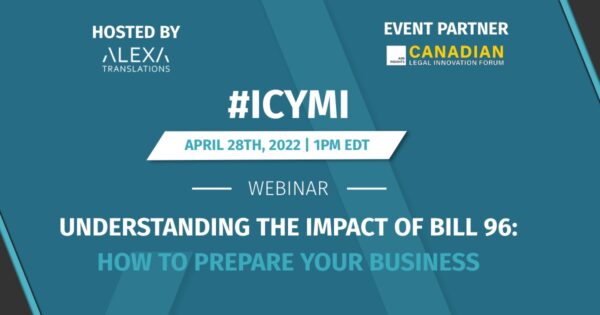
BILL 96 WEBINAR (PART 1) - IN CASE YOU MISSED ITBILL 96 WEBINAR (PART 1) - IN CASE YOU MISSED IT

If you're operating in Quebec, you’ll by now be familiar with Bill 96, the Quebec government’s proposed law that is expected to take effect this summer. The bill will update the Charter of French Language, otherwise known as Bill 101, ensuring that nearly all business contracts, human resources activities, public services, marketing, and just about anything else will be available in French. 

The highly contentious bill has generated applause by some, and protests by others. Whatever your opinion of the new law, you must be prepared to take action before Bill 96 takes effect.

To help explain the impact of Bill 96, we recently assembled a panel of experts including Keyvan Nassiry (Nassiry Law), André de Maurivez (CIBC), Tania Da Silva (DLA Piper), and Gary Kalaci (Alexa Translations). Our panel discussed the general impact of the bill, provided recommendations for all businesses operating in Quebec, and explored the nuances of human resources and contractual law under Bill 96.

Did you miss the webinar? 

Not to worry - you can watch the recorded webinar below, and sign up here for updates about Bill 96 to ensure your business is prepared for the landbreaking new law.

This webinar was part one of our three-part series exploring Bill 96. The other two installments will take place in August and November - sign up here for updates on the upcoming webinars.

Not sure how to prepare for Bill 96? 

We can help. Get in touch with our team today to discuss how you can simplify your translation workflow and ensure you are compliant with Bill 96.

important articles and blog posts

SIGN UP FOR OUR NEWSLETTER
© 2025 Alexa Translations. All rights reserved.
hello world!
Skip to content